October 29, 2026
Agentic Payment
AI agents are starting to buy things on our behalf, but traditional credit cards don't work well for tiny, sub-cent payments. This post maps out the new payment rails—like stablecoins and micropayment protocols—that make autonomous machine transactions possible.
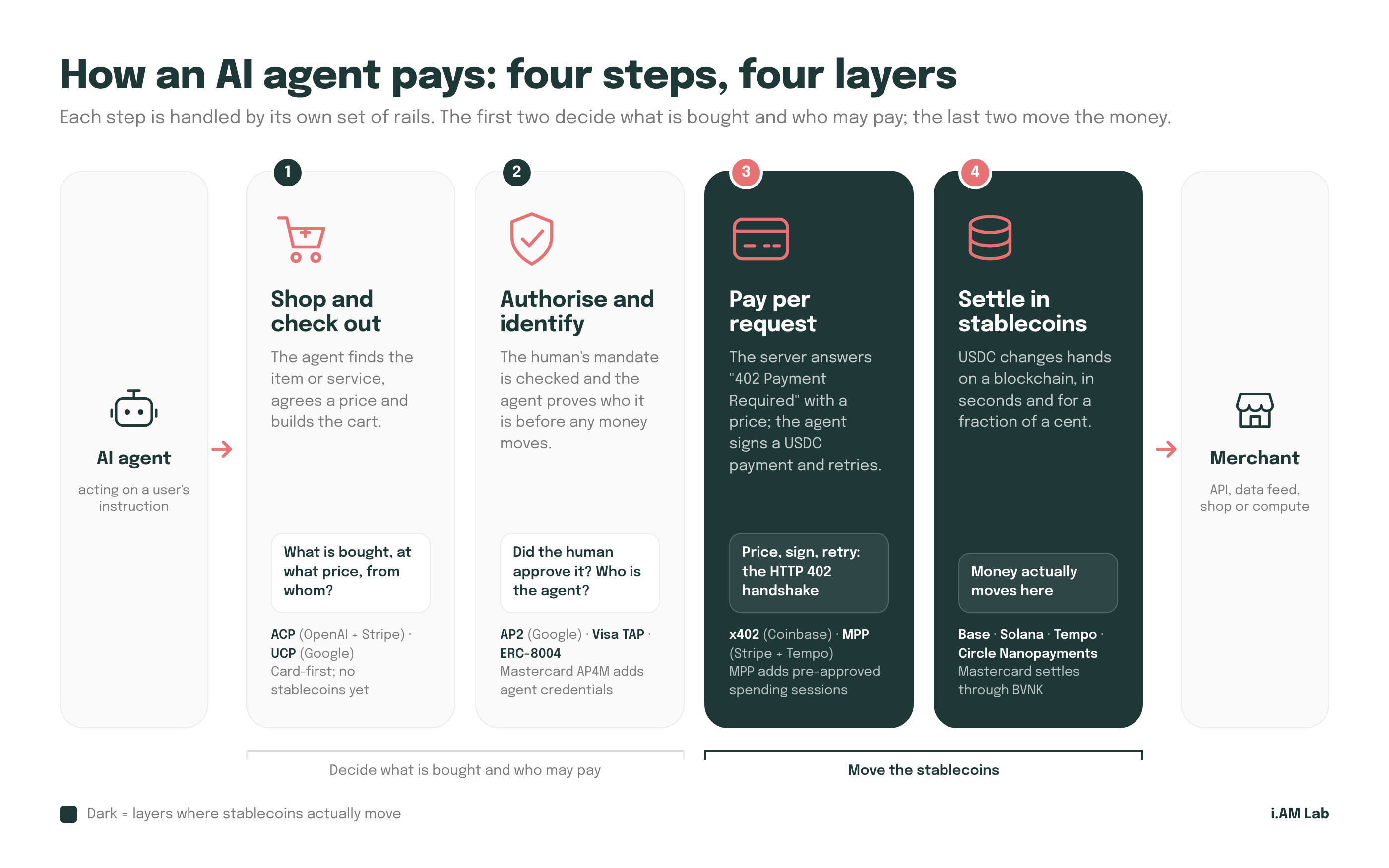
AI agents are getting ready to do business on our behalf. But what does it take to let them spend? Let’s take a closer look at the payment infrastructure that makes it possible.
Imagine asking your assistant to research a topic. To answer, it buys three paywalled articles, rents a data feed and pays for a few seconds of compute, all without you entering a credit card once. Cards and bank transfers can't do this well. They were built for people, need onboarding and charge fees that make a payment of a fraction of a cent pointless. Stablecoins can settle sub-cent payments in seconds, which is why a recent BlackRock insight calls them "machine-native money".
Over the past year, a handful of rails have appeared to make this work. This post maps them: what each one does, who is behind it, and how much it is actually used.
Paying online involves more than moving money. Someone has to agree on what is being bought, prove that the person really authorised it, run the payment and settle it. Today's "agent rails" each cover one or two of these jobs, so they often work together rather than compete.
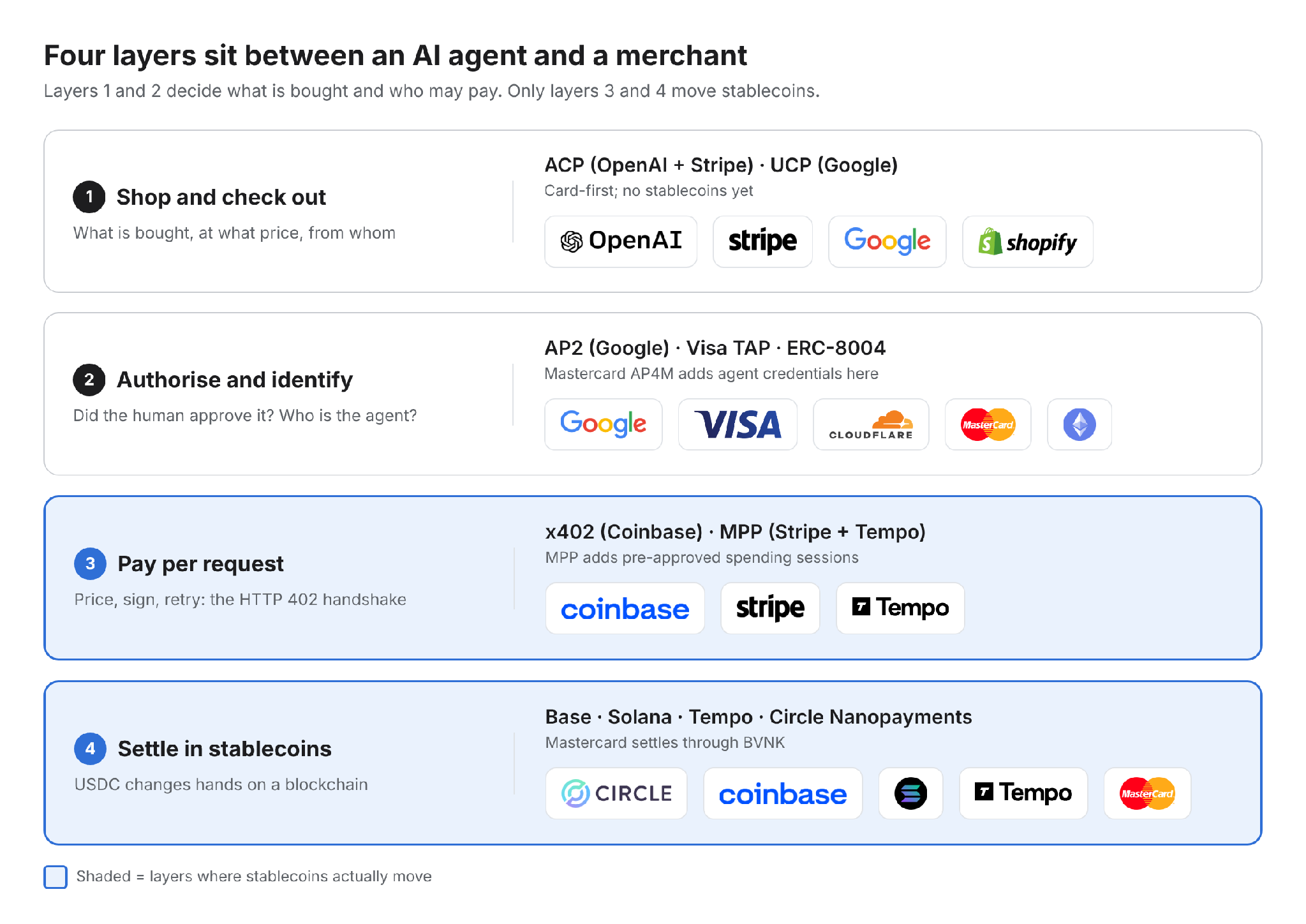
x402 (Coinbase, now the x402 Foundation). It revives an old, unused web status code, "402 Payment Required". An agent asks for a resource, and the server answers with a price. The agent signs a USDC payment and sends the request again, and the content comes back. There are no accounts and no API keys, and the protocol itself charges no fee. Coinbase launched it in May 2025. It is now run by a Linux Foundation body whose 40+ members include Visa, Mastercard, Stripe, Google, AWS and Cloudflare. Payments settle mostly on Base and Solana.
Machine Payments Protocol, MPP (Stripe and Tempo). MPP uses the same 402 handshake but adds two things. The first is sessions: an agent pre-approves a budget once and then streams many small payments within it, like a tab at a bar. The second is choice of money: stablecoins on Tempo, Stripe's own payments blockchain, plus cards through Stripe and Bitcoin Lightning. It went live with Tempo's mainnet on 18 March 2026. By June, 137 services accepted it, with a median price of $0.02 per request.
Circle Nanopayments (Circle). The issuer of USDC tackles the cost problem directly. Agents deposit USDC once, sign each payment off-chain, and Circle settles thousands of them in a single blockchain transaction. That makes payments as small as $0.000001 viable, with no gas fee per payment. It launched on 11 blockchains on 29 April 2026 and plugs into x402 rather than competing with it.
Agent Pay for Machines (Mastercard). Card networks are joining rather than fighting. Mastercard's AP4M, opened to developers on 20 October 2026, is built on x402. Mastercard adds agent credentials and spending limits, and settles through BVNK, the stablecoin firm it bought for $1.8B. It is still a pilot. Visa has taken the same route: it extended MPP to card payments, and its stablecoin settlement ran at about $7B a year by March 2026.
Agent Payments Protocol, AP2 (Google, now FIDO Alliance). AP2 does not move money. It proves that the human really authorised the agent. The user signs digital mandates: an intent ("white running shoes, under CHF 120") and a cart (the exact item and price). The payment is then tied to those mandates, which leaves an audit trail if something goes wrong. Google launched it in September 2025 with 60+ partners and a stablecoin extension built on x402. It moved to the FIDO Alliance in April 2026.
Card-first checkout standards: ACP and UCP. OpenAI and Stripe's Agentic Commerce Protocol (ACP) and Google's Universal Commerce Protocol (UCP) standardise how an agent shops at a merchant: catalogue, cart, checkout. Both pay with cards and wallets (Stripe tokens, Google Pay, PayPal), not stablecoins. They matter because they own the shopping step. Adoption is mixed: OpenAI closed its ChatGPT Instant Checkout in March 2026 after near-zero sales.
Identity layers: Visa TAP and ERC-8004. Before paying an agent, a merchant wants to know who it is. Visa's Trusted Agent Protocol, co-developed with Cloudflare, lets approved agents sign their requests. On Ethereum, ERC-8004 gives agents an on-chain identity and reputation score. It had over 1 million registrations within weeks of its January 2026 launch.
Only the first four rails move stablecoins themselves. The rest decide who is allowed to pay and what is being bought.
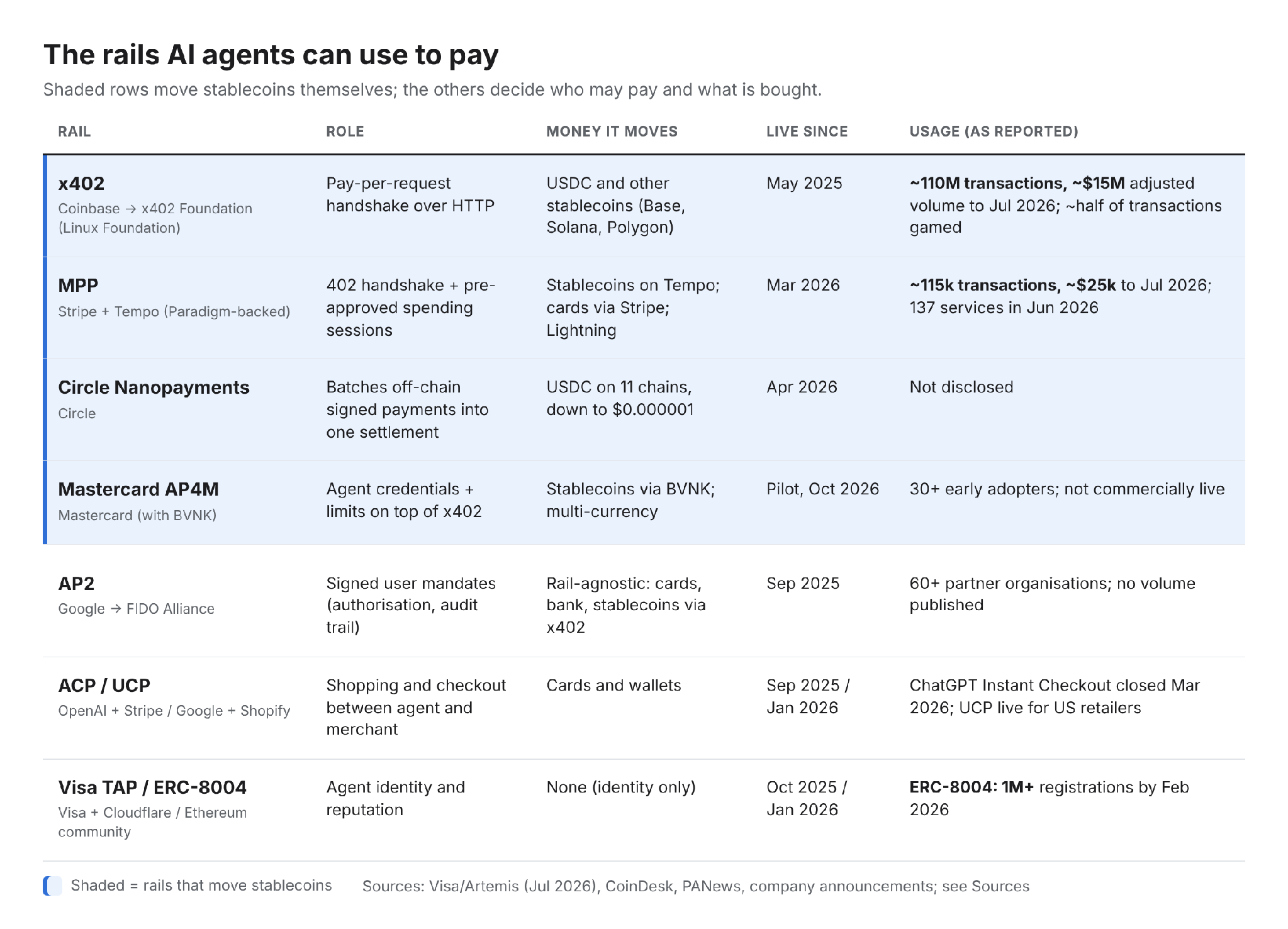
Usage figures come from different trackers and methods, and they disagree widely. For x402, 30-day estimates in March 2026 ranged from under $2M (Artemis) to $24M (x402.org) (MEXC/a16z). Treat them as orders of magnitude.
The plumbing exists, but the traffic doesn't yet. x402, the largest rail, has settled about $15M of real volume in over a year. Visa and Mastercard together process trillions. For now, agent volume is a rounding error.
Three trends are worth watching:
For businesses, the practical first step is small: put a price on one API or dataset and let agents pay per call.