

Introduction
In collaboration with Schroders Capital and Hannover Re, we tokenized an insurance linked warranty on the polygon blockchain accessible via a private web portal. The initiative explored how blockchain infrastructure can accommodate for a more efficient and cost-effective way to transfer catastrophe risk between capital markets and reinsurance market
The starting point
While the traditional ILS market historically requires heavy operational efforts and is very costly due to many involved parties and complex legal structures, we saw opportunities in leveraging emerging blockchain technology to operate these deals more efficiently and cost-effectively.
This proof of concept addressed the following problems:
- Structuring deals is manual and slow
- Investor onboarding is fragmented and costly
- Transactions lack transparency and real-time visibility
- Capital is usually trapped for multiple years
- Documentation and lifecycle management are highly operational
For capital providers, this means:
- High barriers to entry
- Long settlement cycles
- Capital Lock-In
For (re)insurers, it means:
- Inefficient capital access
- Reduced scalability of risk transfer
- Operational overhead
The Concept of What We Built
We have developed a blockchain-based infrastructure that tokenizes ILS contracts, turning them into digitally native, programmable financial instruments that directly bind capital to agreed legal terms.
Why Blockchain
What sets blockchain technology apart from the traditional web is its decentralized settlement. In the traditional web, a payment is just a request for a middleman (like a bank) to update their private spreadsheet. On the blockchain, the "spreadsheet" is public and shared.
The breakthrough is that the blockchain network replaces the bank with cryptographic proof. This allows for Atomic Settlement: the transfer of value and the transfer of ownership happen simultaneously and irreversibly. Because there is no central authority to "permit" the transaction, money becomes programmable code that moves as freely and instantly as an email, but with the security of a physical vault. As a result, we can write computer programs that move assets if being triggered by pre-defined inputs.
How and why we applied this to insurance linked warranties
While this decentralized settlement is generally interesting for automating structured investment vehicles, we identified insurance linked warranties as the ideal use case because they rely on binary triggers (e.g. if a named storm in the USA exceeds an overall damage of $300B pay out 20% of the collateral) and massive liquidity pools that suffer from high administrative friction.
In traditional markets, an ILW often faces "settlement lag" where capital is trapped for weeks while loss adjusters and intermediaries verify if a catastrophe threshold was met. By applying decentralized settlement, we transform the ILW from a slow legal contract into a smart contract through following components:
Trusted market data
PCS & PERILS are the leading data providers for the insurance market. Based on the data they reported through the web portal to the smart contract a payout either was triggered or not.
Instantaneous payouts
The moment the reported data hits the predefined trigger (e.g. the recorded damage exceeds >$300B), the Atomic Settlement occurs. The shared "spreadsheet" updates instantly, moving the collateral from the smart contract to the reinsurer without a single bank transfer request or manual approval.
Collateral efficiency
Because the blockchain acts as a physical vault, the capital is locked and guaranteed. This eliminates counterparty risk – the (re)insurer knows the funds are there and the capital provider knows they can only be released if the specific trigger conditions are met. No need for dispute resolution as both parties agreed to the conditions by placing their assets into the smart contract.
How i.AM Lab delivered it
- To kick it off we held lessons on blockchain basics and how to interact with the blockchain using personal wallets
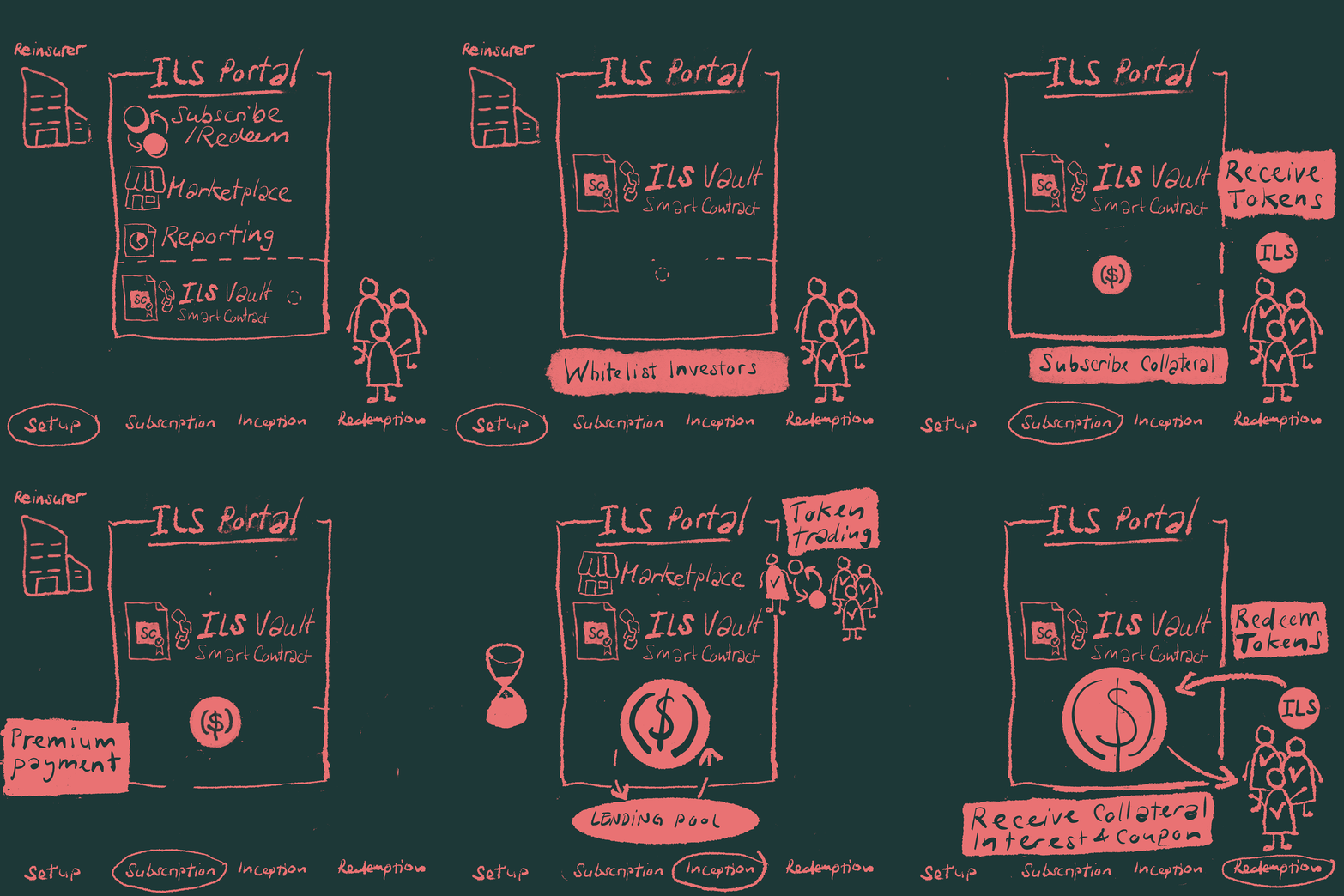
- We translated an industry loss warranty agreement into a smart contract on the polygon blockchain by encoding the risk terms, payout triggers, participants and total capital needed.
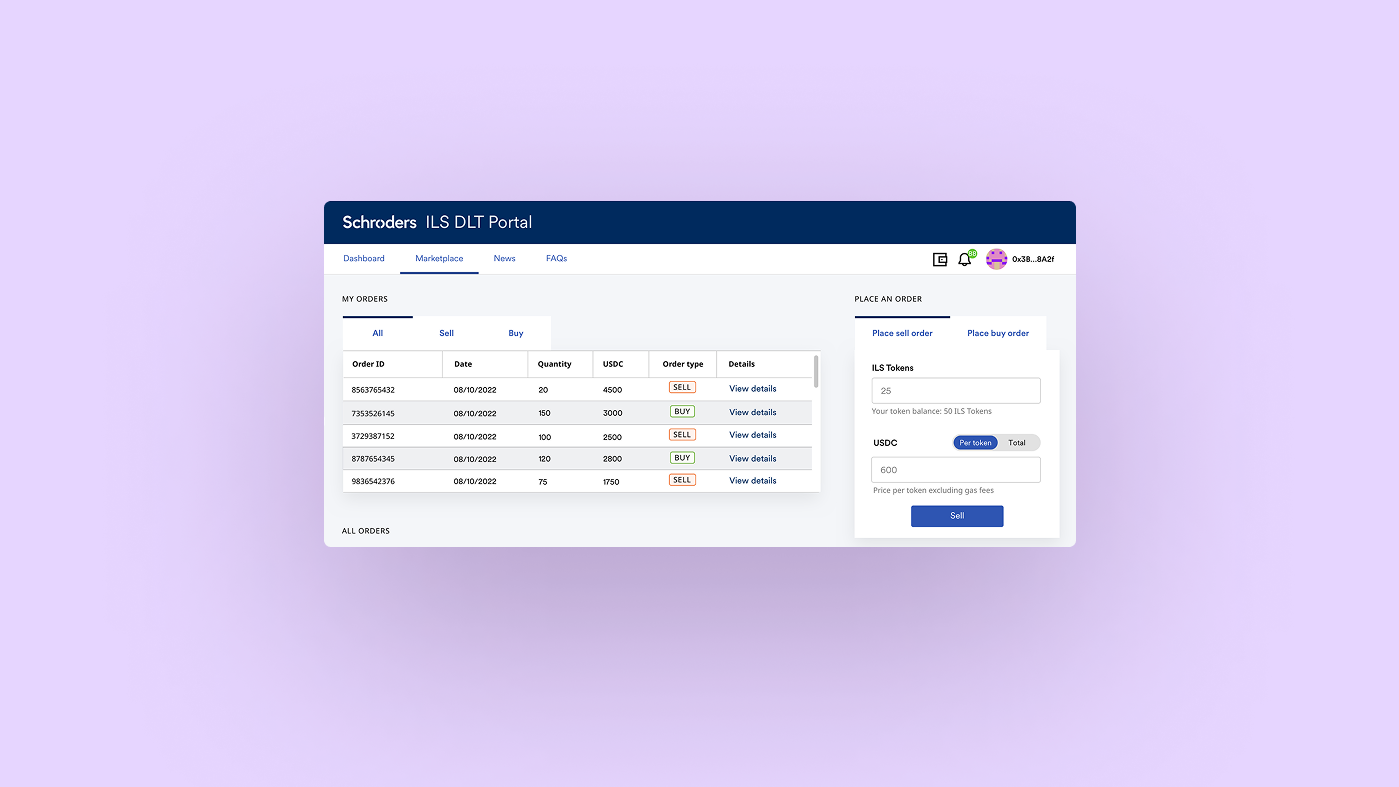
- Investors, Reinsurer & Reporting Agent wallets have been whitelisted for accessing a user friendly web portal to interact with the smart contract through personal wallets.
- The reinsurer connects their wallet to the web portal and acquires USD coins. The required premium is transferred to the ILS Vault smart contract.
- Investors individually acquire USD coins through the web portal and subscribe to the agreement by transferring USD coins to the smart contract and receiving ILS tokens in return (determined by a set price) representing their share of the investment cell.
- On an internal marketplace whitelisted investors are able to trade their positions 24/7 on a peer-to-peer basis by placing/accepting buy or sell orders.
- The reporting agent reports the damages of occurred events to the web portal.
- The smart contract instantaneously checks if the event triggers a payout based on the encoded trigger. If the value exceeds the attachment point a payout is being calculated and executed based on the size of the damage.
- As the deal matures the remaining collateral is returned to the investors based on their token holdings.
Benefits of this Setup
For Capital Providers (Investors)
- Lower entry barriers into ILS
- Fractional access to deals
- Increased transparency on risk and returns (public ledger)
- Instant settlement and reduced admin overhead (no disputes)
- Secondary market liquidity
For (Re)Insurers
- More efficient access to capital markets
- Faster deal execution cycles
- Reduced operational complexity
- Greater scalability of risk transfer structures
- Improved investor reach
Our Contribution (i.AM Innovation Lab)
- Designed the smart contract & web portal architecture
- Built and deployed the contracts (audited, pentested)
- Implemented and designed lifecycle logic
- Developed the platform and user experience
- Supported vendor selection and infrastructure decisions
- Aligned and educated stakeholders across both organisations
What makes this project a success
We implemented a proof of concept covering a full lifecycle of an ILW with 50 professional investors involved in a transaction with a total size of $30’000 using PCS and PERILS data streams to trigger automated payouts on a public blockchain.
In addition to that we proved that we can transform the technological infrastructure of institutional players to improve efficiency and transparency and build the foundation for a more scalable future.
Conclusion and Outlook
This project proves that blockchain technology is ready for a wider industry adoption and will transform how transactions are operated, secured and controlled and underscores i.AM Innovation Lab’s commitment to drive digital transformation in financial markets through practical and scalable innovation.