
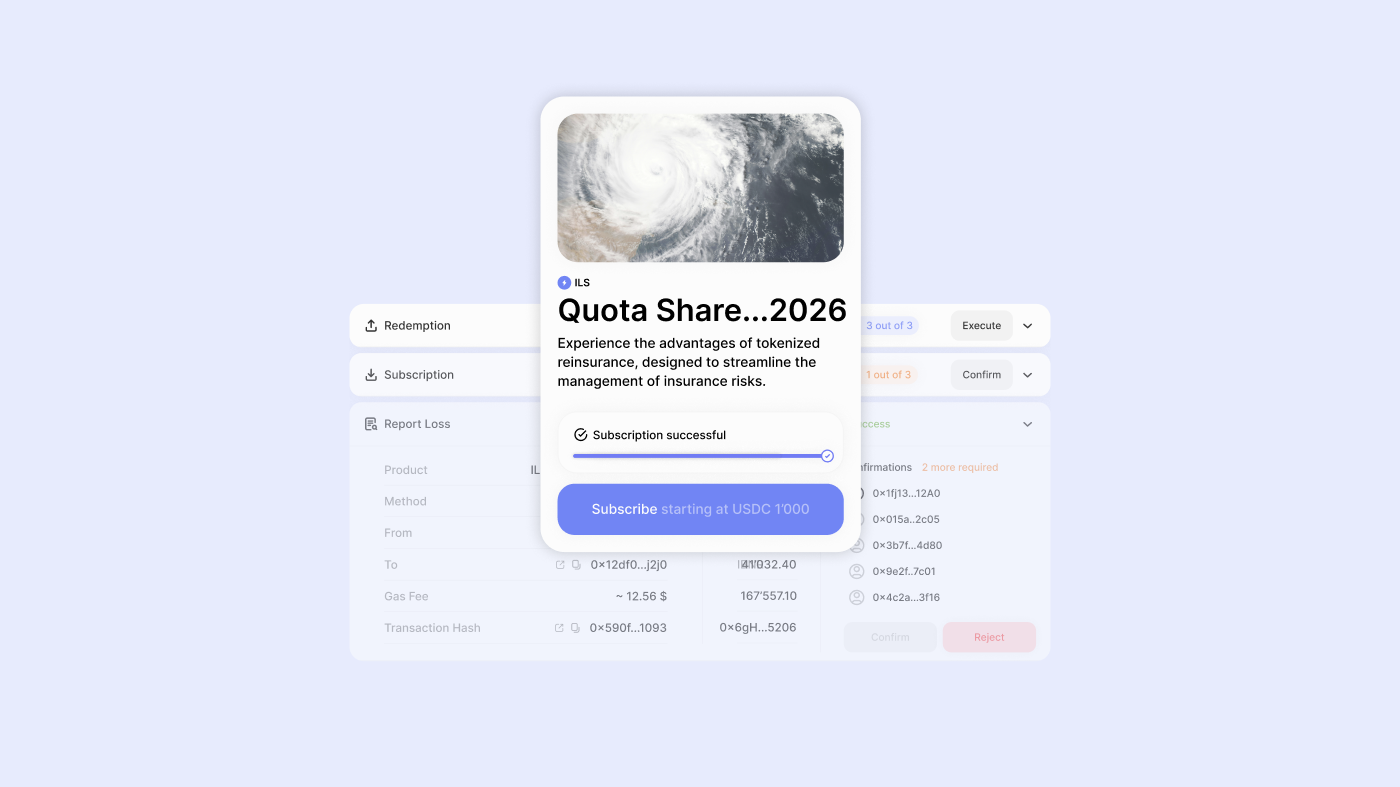

ILS One – A Digital Infrastructure for Insurance-Linked Securities
Introduction
Following our collaboration with Schroders Capital, the private markets specialist within the Schroders Group, and Hannover Re, a leading global reinsurer on a project to tokenize an insurance-linked securities (ILS) transaction, we launched ILS One, a digital platform designed to tokenise ILS and materially enhance operational efficiency.
Through this initiative, the i.AM Innovation Lab successfully enabled a quota share reinsurance agreement to be represented, executed, and settled via smart contracts on a public blockchain. The project demonstrates how core reinsurance structures can be translated into programmable, auditable systems while maintaining institutional governance, security, and control standards.
The starting point
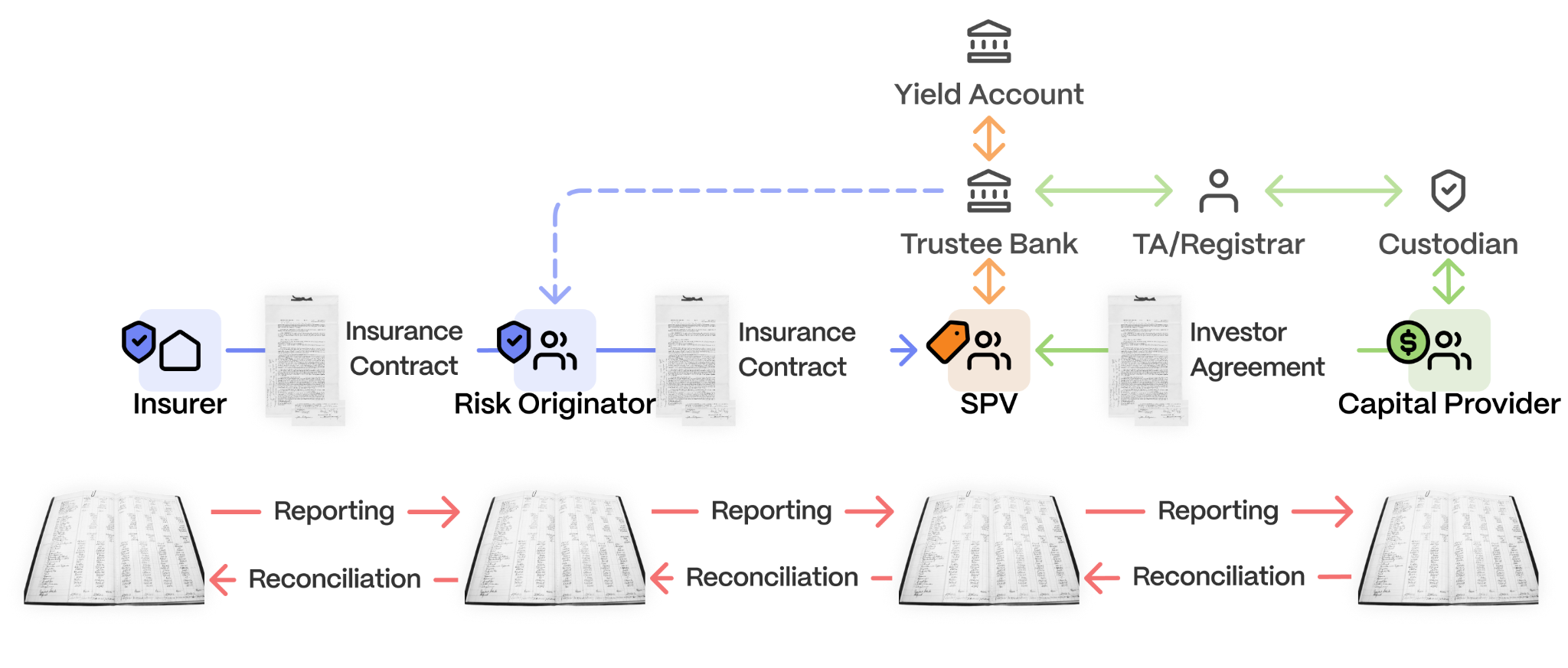
ILS and reinsurance transactions are capital-intensive and operationally complex. Their primary objective is to provide insurers with the capital required to underwrite risk and meet claims arising from insured events, such as property damage. However, the execution model underpinning these transactions remains largely manual and fragmented.
Key structural challenges include:
Multi-party coordination of capital flows
Transfer agents, custodians, trustees, fund administrators, and brokers must align processes and timelines across multiple organisations.
Manual reconciliation across disconnected systems
Critical data such as bordereaux and settlement figures, is reconciled across datasets and email exchanges, increasing operational risk and overhead.
Annual settlement and capital lock-up cycles
Collateral provided from investment funds is usually trapped for extended periods, reducing capital efficiency.
Limited Scalability
While the current model functions, each additional transaction increases operational complexity and cost, constraining growth.
The Solution: ILS One
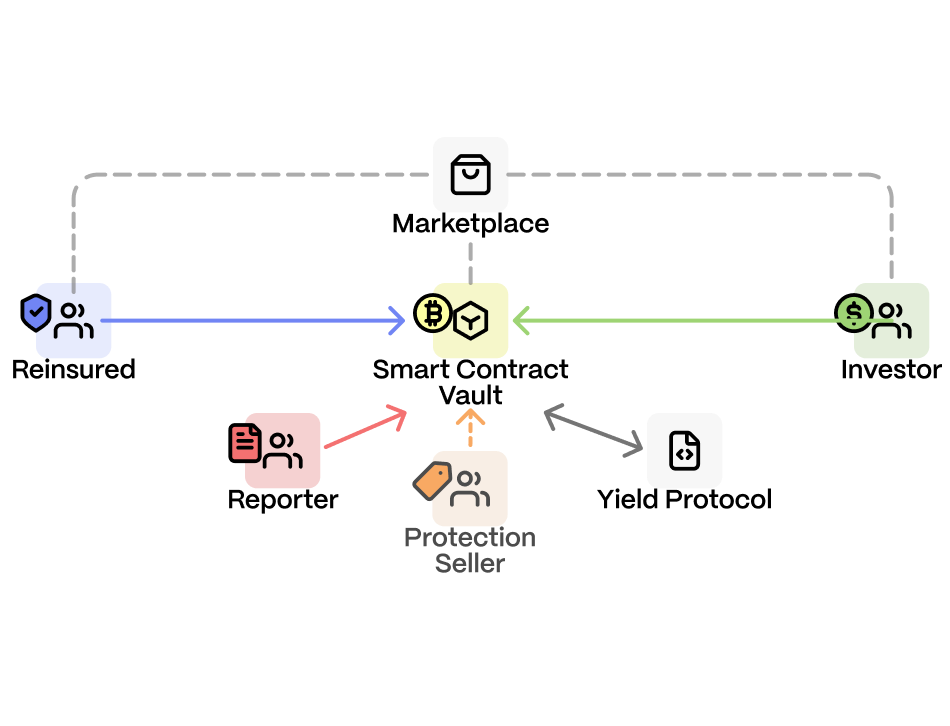
ILS One is a scalable smart-agreement infrastructure that brings both contractual logic and capital flows onto blockchain infrastructure—without requiring participants to interact directly with the underlying technology.
At its core, each quota share transaction is represented by a smart contract that:
- Clearly defines roles and permissions
- Encodes profit and loss settlement rules
- Manages collateral in accordance with predefined contractual logic
A smart contract functions as autonomous software deployed on a public blockchain, accessible only to whitelisted institutional participants. It can securely hold and transfer digital assets — such as USD-denominated stablecoins—and execute transactions automatically based on agreed rules.
By replacing manual coordination across emails, spreadsheets, and intermediaries, the smart contract enforces consistent execution and transparent settlement.
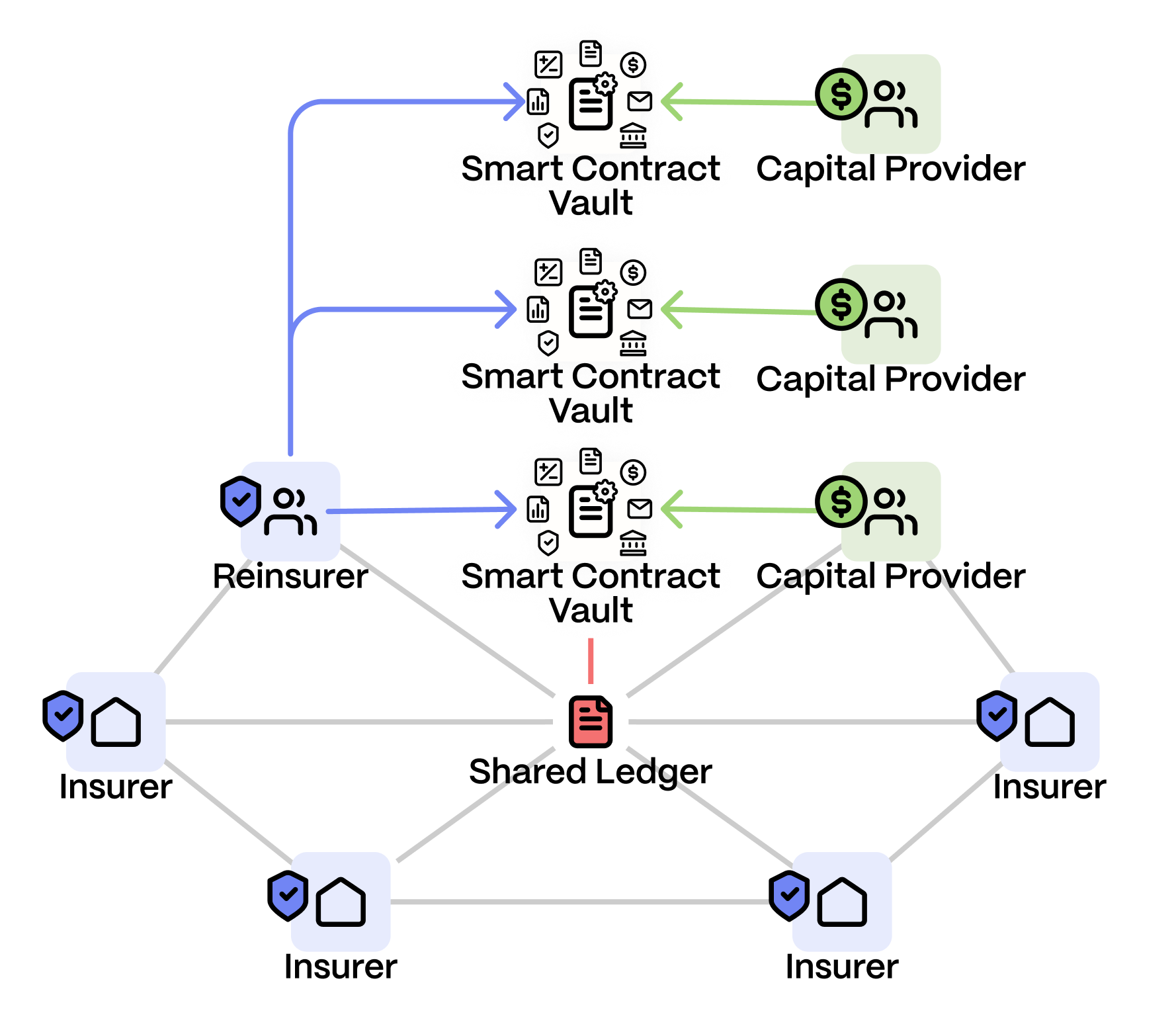
ILS One is designed to scale efficiently. Each new transaction runs on the same execution framework, eliminating incremental operational burden. Increased underwriting volume does not introduce additional complexity; it operates on identical, programmable infrastructure.
How the Platform Operates in Practice
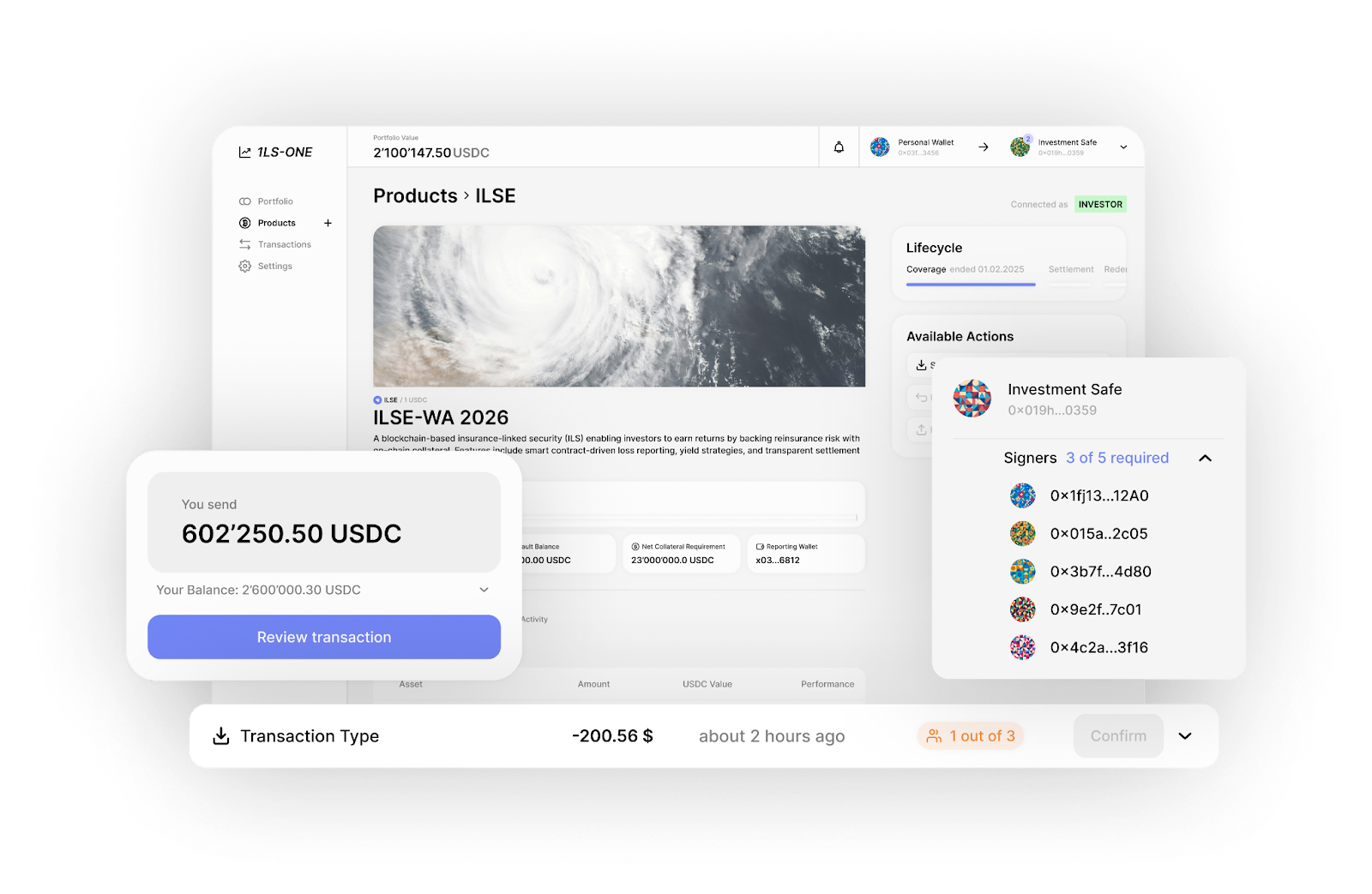
Authorised users access ILS One using their corporate credentials. Each user is associated with a wallet address linked to their organisation.
Key operational features include:
- Multi-signature company wallets, ensuring that fund transfers require internal approval
- Role-based permissions, enabling participants to interact with smart contracts only within their authorised scope
- On-chain collateral management
Collateral is allocated into a tokenised money market fund investing primarily in investment grade U.S. Treasury instruments. In return, investors receive a token representing their proportional interest in the collateral via an atomic swap mechanism.
During the risk coverage period:
- The protection buyer may draw down collateral in line with bordereaux results
- Surpluses or profits trigger automated repayments or top-ups
- Where appropriate/agreed, token holders may trade positions peer-to-peer on a permissioned digital marketplace
At maturity, token redemption triggers an automated release of funds in accordance with the predefined collateral release schedule.
Benefits for Capital Providers and (Re)Insurers
For capital providers:
- Full on-chain transparency of transactions and balances
- Secure digital monitoring and management of assets
- Automated release of previously trapped collateral
- Reduced reliance on traditional custodians and transfer agents
- Compounding returns on insurer payments
- 24/7 peer-to-peer secondary market liquidity (subject to permissions)
For (re)insurers:
- Near-instant access to collateral for claim payments
- Reduced operational friction and manual processing
- Fewer intermediaries and improved settlement certainty
- Access to new, digitally enabled capital distribution channels
Our contribution
Our support of the initiative became the genesis of ILS One and included the following:
- Designing the smart-contract architecture
- Building, auditing, and deploying production-grade contracts
- Developing the platform and user experience
- Defining wallet, custody, and governance structures
- Integrating on-chain investment and settlement flows
- Supporting vendor selection and infrastructure decisions
- Aligning stakeholders across multiple institutions
A significant portion of the work extended beyond technology. It involved translating established institutional processes into a new execution model and enabling parallel operation alongside existing frameworks.
What Defines Success
ILS One does not represent a fully displaced operating model, but a practical bridge between traditional infrastructure and blockchain-based execution.
Retaining selected legacy components was a deliberate design choice to ensure interoperability and institutional adoption. The focus was on evolution rather than disruption, integrating new technology into existing governance, risk, and control frameworks.
The project demonstrates that:
- Institutional market participants can operate securely on public blockchain infrastructure
- Complex reinsurance processes can be translated into programmable systems
- Digital execution can coexist with established legal, operational, and governance standards
Conclusion and Outlook
ILS One illustrates how blockchain and smart contracts can modernise structured investment products by enhancing automation, transparency, and capital efficiency.
In partnership with Schroders Capital and Hannover Re, we have demonstrated the feasibility of tokenising reinsurance transactions on a public blockchain under real-world constraints. The platform moves live transactions on-chain today while remaining adaptable for future clients and structures.
ILS One is not a proof of concept, it is a working foundation for the next generation of institutional risk transfer infrastructure.